Horror is a genre about endings. Television is a business built on not ending. That contradiction is why so much horror TV runs out of fear by episode four, and the five shows below are the ones that found a way around it. Each solved it differently, and two of them have new episodes coming.
A horror film has ninety minutes to frighten you and then it is allowed to stop. A series has to keep going, which means it has to keep explaining, and explanation is the enemy of fear. The thing in the woods is terrifying for exactly as long as nobody has told you its name, its rules and its backstory. Most horror shows spend their second season doing all three.
So the interesting question is not which horror show has the best jump scares. It is which ones found something that could survive being watched for ten or twenty or a hundred hours. The five here each found a different answer: a family, a reset, a sermon, a border you cannot cross, and the weather.
How this list is ranked, and the odd thing about horror on TV
Two rules. First, horror has to be what the show is, not an ingredient in it. That single line does most of the work below, and it is why several enormously popular series are discussed in a section near the end rather than in the ranking. Second, it has to work as television specifically. A good three-hour film stretched to eight hours is not a good series, it is a slow film.
Here is the odd thing you run into the moment you try to browse for this. TMDB, which is the database behind this app and most others, has a Horror genre for films and no Horror genre for television at all. The TV list runs Action & Adventure, Animation, Comedy, Crime, Documentary, Drama, Family, Kids, Mystery, News, Reality, Sci-Fi & Fantasy, Soap, Talk, War & Politics, Western. That is the entire list. There is no horror in it.
Which means every show below is filed under something else. The Haunting of Hill House is Mystery and Drama. American Horror Story, which has the word in its title, is Drama, Mystery and Sci-Fi & Fantasy. FROM is Mystery, Drama and Sci-Fi & Fantasy. You cannot filter a TV feed down to horror because, as far as the metadata is concerned, horror television does not exist. That is a decent argument for a ranked list written by a person.
In 1845 two Royal Navy ships, the Erebus and the Terror, sailed to find the Northwest Passage and were never seen again by anyone who could report back. The ice took them. AMC's first season, ten episodes broadcast across the spring of 2018, is an adaptation of Dan Simmons' 2007 novel about what might have happened in the years between the ships freezing in and the last man dying.
It is the only period drama on this list and the only one with a monster you could describe as a monster. The Tuunbaq is Simmons' invention rather than anything from the historical record, and it stalks the crew across the ice. But the show is quietly clever about it: the creature is the least of what kills these men. Scurvy is worse. Lead is worse. Command is worse. Jared Harris plays Francis Crozier as a functioning alcoholic who happens to be the only officer reading the situation correctly, opposite Ciarán Hinds as Sir John Franklin and Tobias Menzies as Fitzjames, and the tragedy is that being right is not the same as being listened to.
What makes it horror rather than history is the slowness. There is no way out, no rescue coming, and the thing the show is genuinely frightening about is duration: the crew waits, and waits, and the ice does not move, and the food runs down. Very few series have the nerve to make waiting the antagonist.
It is an anthology, so nothing carries over. Season two, Infamy, moved to a Japanese American community in the internment camps of the Second World War and aired in 2019. A third, The Terror: Devil in Silver, arrived on Shudder and AMC+ on 7 May 2026 and ran six episodes inside a psychiatric hospital. Start with the ice.
A town in the middle of America that you can drive into and cannot drive out of. Every road loops back. The people already living there have built a functioning society out of nothing but the fact that they are stuck, and the rules are simple: the things in the forest come out at night, they look like people, and a talisman over the door is the only thing keeping them out. Harold Perrineau plays Boyd Stevens, the sheriff of a place with no county, and the performance is the show's spine.
The reason it works over four seasons where a hundred mystery-box shows have collapsed is that it never pretends the mystery is the point. The horror is the arrangement. Every episode is someone deciding whether to be decent inside a system that punishes decency, and the monsters are just the mechanism that makes that decision cost something. When the show does answer a question, it usually opens a worse one.
The numbers back the enthusiasm. It holds 8.5 on TMDB from over four thousand votes, the highest score of anything on this list, and MGM+ has called it the most-viewed series in the network's history. Season four premiered on 19 April 2026 and ran ten episodes, taking it to forty in total.
It has also, unusually, been given an ending. MGM+ renewed it for a fifth and final season just before season four aired, so the writers know where the last scene is. Season five shoots in Halifax and is expected in 2027. If you have been waiting for it to be finished before starting, you now have a date to work back from.
A dwindling island community of a few hundred people gets a new priest, and the congregation starts filling up again, because things have begun happening in that church that people cannot explain and do not want to. That is as much as you should know. It is seven episodes on Netflix, released on 24 September 2021, and it is the most personal thing anyone on this list has made.
Its route to the screen is the best story in horror television. Mike Flanagan wrote it as a novel first, then as a film script, and pitched it around unsuccessfully in 2014. Nobody wanted it. So in 2016 he put the book itself on screen as a prop in Hush, where it is the fictional novelist's most popular title, then planted the same prop again in Gerald's Game in 2017. He has described it as a way of keeping the idea alive over the years. It took seven years and two Easter eggs to get made.
The thing everyone remembers is the talking. Hamish Linklater plays Father Paul Hill in what amounts to a series of sermons, pages long, shot in single takes, and they are genuinely the scariest passages in the show, because you can feel the argument working on you before you have decided whether you agree with it. Samantha Sloyan as Bev Keane is the other half of that: a woman who has read the same book and drawn conclusions that would frighten anyone. Zach Gilford, Kate Siegel and Rahul Kohli carry the rest.
It reviewed at 87 percent on Rotten Tomatoes and 75 on Metacritic, which undersells it slightly. This is a horror show about addiction, grief, and what faith looks like when it stops being a comfort and starts being an instruction, and it is willing to sit for four minutes on a monologue and trust you to stay. It is also the only entry here that ends properly, in seven episodes, with nothing left over.
Twelve seasons have aired since 2011, a hundred and thirty-two episodes of them, and no two are the same programme. A haunted house in Los Angeles. A Catholic asylum in 1964. A witches' academy in New Orleans. A dying freak show in Florida. A hotel, a lost colony, a cult, an apocalypse, a slasher summer camp, a double feature, New York in the early eighties, a fertility clinic. The cast comes back. The story never does.
That reset is the single most important structural idea in modern horror television, and it is the direct answer to the problem this article is about. A horror premise cannot be extended indefinitely, so Ryan Murphy and Brad Falchuk simply stopped extending them. Every season gets a beginning, a middle and an ending, and then it is over and the furniture is thrown out. Nothing here has to survive being explained for six years, because nothing here lasts six years.
The industry noticed before the audience did. The Emmy miniseries categories were quietly dying when the show launched, and it revived them by proving there was still an appetite for a story told over several weeks rather than several years. The series has taken seventeen Emmys. Jessica Lange won for Murder House in 2012 and again for Coven in 2014, and Kathy Bates won for Coven the same night.
The repertory company is the other half of the trick, and it is the part that keeps people watching a show they have complained about for a decade. Sarah Paulson has been in a hundred and eight episodes and Evan Peters in ninety-nine, playing entirely unrelated people in each. Denis O'Hare, Lily Rabe, Frances Conroy, Kathy Bates and Angela Bassett have all passed forty. Watching the same faces reincarnate every autumn is a pleasure no anthology film series can offer.
The honest caveat, and it is the reason this is second rather than first: the gap between the best season and the worst is enormous. Nothing else on this list is that inconsistent. But the format is also what makes that survivable, because a bad year costs you one story rather than a show, and the next October it is somebody else's house.
It is also the most timely pick here. Season thirteen, titled simply 13, premieres on FX on 24 September 2026, with three episodes in each of the first two weeks and two a week after that, running to a finale on 29 October. Murphy has described it as the Avengers of American Horror Story, with the cast converging to face one enemy, and Jessica Lange is back. If you have never started, you have about a month to get through a season and find out whether you want to be there for it.
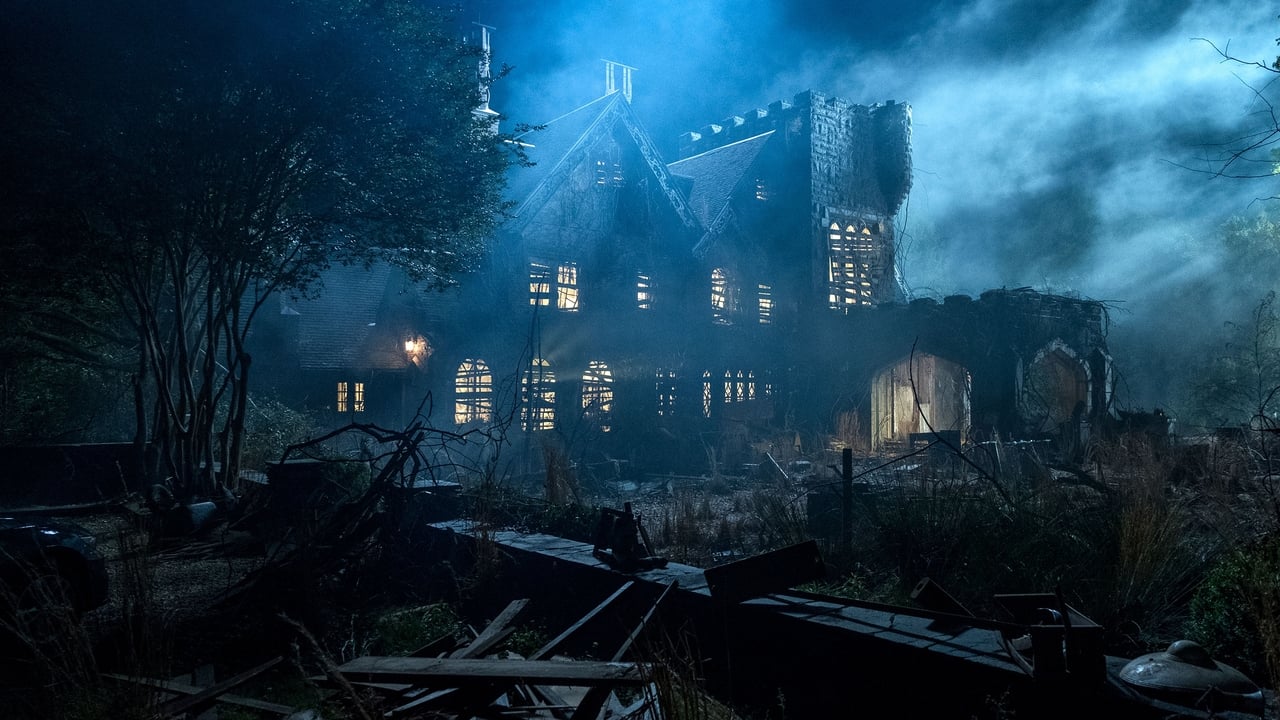
Shirley Jackson's 1959 novel is about four strangers in a house. Flanagan's ten-episode version, released on Netflix in 2018, keeps the house and throws out the strangers, replacing them with the five Crain siblings and the summer their parents moved them in. Half the show is that summer. Half is twenty-six years later, when one phone call brings all five of them back into a room together.
That restructuring is the reason it is first here. A haunted house cannot sustain ten hours. A family arguing about what happened in a haunted house can sustain twenty, because every sibling remembers a different version and every version is partly a lie they have told themselves to keep functioning. The show is a ghost story on the surface and a story about grief, addiction and inherited damage underneath, and it never has to choose, because in this show those are the same thing.
The centrepiece is episode six, Two Storms, staged to look like one unbroken shot. It is not quite: it is five long takes, three in the funeral home and two in Hill House, and the longest runs around seventeen minutes. Most of the camera choreography was written into the script itself, which made the draft a punishing read, and Flanagan shot a full-length version of the whole episode with stand-ins before the cast ever walked on. What it buys is an hour in which nobody can cut away from anybody, which is unbearable in exactly the right way. Carla Gugino, Timothy Hutton, Victoria Pedretti and Oliver Jackson-Cohen do the heaviest lifting.
It is also the best-hidden show on this list. Ghosts stand in the backgrounds of ordinary scenes, unlit, uncommented on, sometimes for a full minute, and the series never draws attention to a single one. Nobody catches them all on a first pass. That is the trick that makes the rewatch a different programme from the watch, and it is a trick only television has the running time to pull off.
Do not read anything about episode five before you get there. It contains the best single reveal in modern horror television, it is set up from the first episode, and knowing it in advance costs you the whole show.
The first rule up top, that horror has to be what a show is rather than an ingredient in it, cuts several of the most popular series on television. That is an argument rather than an oversight, so here it is with the numbers attached.
Stranger Things: the most-voted show anywhere near this list, at 8.6 on TMDB from more than twenty-one thousand votes, and it ran five seasons to 2025. It is also an adventure series about children on bikes, with horror set pieces in it. TMDB files it under Action & Adventure first, which is right.
The Last of Us: magnificent, and a road drama. The infected are the weather in it, not the subject. TMDB has it as Drama with nothing else attached, and that is not a tagging error.
The Walking Dead: eleven seasons and one hundred and seventy-seven episodes, which is the most impressive endurance run in the genre's history. But it stopped being about being afraid of the dead somewhere around season three, and became a series about factions and governance with corpses in the background.
Twin Peaks: contains, in the third season, the single most frightening hour ever broadcast on American television. It is still not a horror series, and pretending otherwise to claim it would be cheating.
The closest call in the whole piece is Hannibal, which held second place in an earlier draft of this list and is the best-directed television any of these people made. Three seasons on NBC between 2013 and 2015, Mads Mikkelsen opposite Hugh Dancy, cancelled in June 2015 after ratings that Bryan Fuller himself cheerfully called Cancellation Bear Chow. It comes off on the first rule rather than on quality: TMDB files it as Drama and Crime, and that is right. It is a crime series about two men, shot in a horror register, and the register is not the same as the subject. If you disagree, you are probably right, and it is the first thing to watch after the five above.
The deep cut is Channel Zero, Nick Antosca's Syfy anthology, which ran four seasons and twenty-four episodes between 2016 and 2018 and adapted internet horror stories into the most purely unsettling images on television. It has 320 votes on TMDB, fewer than a tenth of anything in the top five, which is the entire story of why you have not seen it. It also ran the same reset that put the show above at number two, on a fraction of the budget, and almost nobody noticed.
Three more worth your time that missed on space rather than merit: Bates Motel, five seasons of a genuinely great Norman Bates that nobody expected from A&E; Penny Dreadful, which put every Victorian monster in one room and gave Eva Green the best role of the decade; and Yellowjackets, which is a survival drama four days a week and something much worse on the other three.
The pattern in the top five is hard to miss. Three of them knew how long they were going to be before they started, one was given an ending before its final season aired, and the fifteen-year-old one has been finishing and starting over every single autumn since 2011. Horror does not survive being extended indefinitely. It survives being finished.
Which one to start tonight
The ranking is about the shows. The watching order depends on what you have got: how many evenings, and how much you want to be upset.
One evening: Midnight Mass. Seven episodes, one location, a complete ending, and no risk of a second season undoing it.
You want to be frightened tonight: The Haunting of Hill House. It works from the first episode and it does not need you to be patient with it.
You want something to live in: American Horror Story. Start with Murder House or Asylum, skip anything you are not enjoying, and be caught up enough for the new season on 24 September.
You want to be watching along with people: FROM, four seasons down and a final one coming in 2027, which is the only entry here where you can still be theorising in real time.
You want cold: The Terror. Best watched in one or two long sittings in winter, which is either the worst or the best advice in this article.
The Conjuring, The Exorcist, The Exorcism of Emily Rose, The Amityville Horror and The Strangers: the real cases behind each film, and how much is true.